WebRTC Technology Era
Technology
|
2010-Now
WebRTC (Web Real-Time Communication) represents one of the most transformative developments in modern internet
communication technology. Introduced in 2011 as an open-source initiative led by Google, WebRTC fundamentally
changed how browsers, mobile applications, cloud platforms and communication systems handle real-time audio,
video and data transmission.
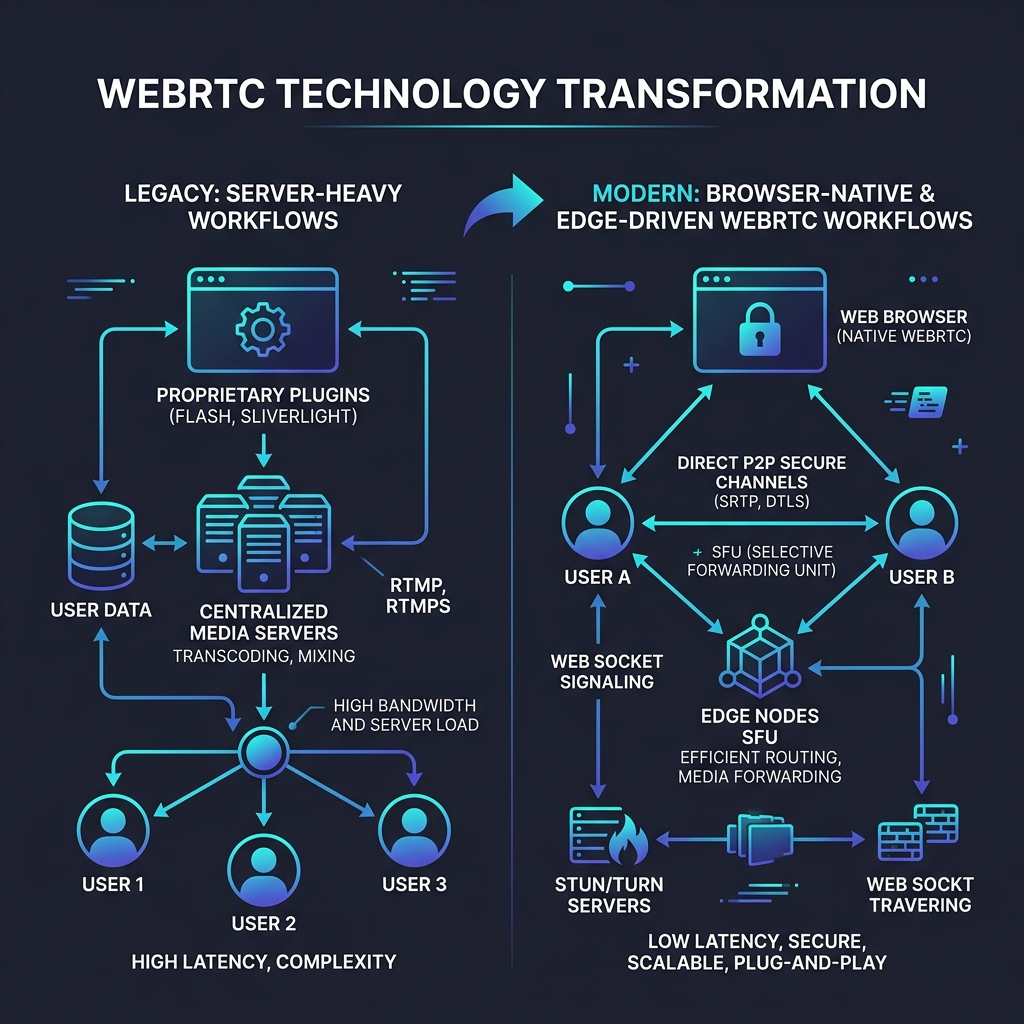
Before WebRTC, browser-based communication was fragmented across proprietary, plugin-based ecosystems such as
Adobe Flash,
Java Applets, SIP browser plugins and closed VoIP environments. These solutions suffered from severe security
vulnerabilities,
poor mobile compatibility, licensing restrictions, high CPU usage and intense vendor lock-in. Real-time
communication required
external runtimes, manual updates and complex client configurations.
WebRTC fundamentally transformed this landscape by introducing standard, browser-native support for secure,
low-latency,
peer-to-peer communication without requiring plugins or proprietary environments. It provided standard, native
APIs enabling:
- Real-time voice and video communication with native acoustic echo cancellation and
automatic noise reduction.
- Low-latency data transfer via high-performance peer-to-peer data channels.
- Secure media and data streams, encrypted by default at the browser level.
The evolution of WebRTC was not purely technical; it involved intense browser wars, standards conflicts, codec
licensing
debates, telecom carrier politics and competing architectural philosophies proposed by major players like
Google, Mozilla,
Microsoft, Apple and Cisco. Over the last decade, WebRTC has matured from an experimental browser framework
into
foundational global communication infrastructure powering Zoom, Google Meet, Discord, conversational AI agents,
and edge streaming systems.
Legacy Communications
Adobe Flash and Air
During the late 2000s and early 2010s, Adobe Flash became the dominant platform for browser-based media
communication. Flash enabled:
- Browser video chat
- Media streaming
- Webcam access
- Audio communication
- Interactive multimedia applications
Media Server and RTMP
Flash-based real-time communication was highly dependent on centralized, third-party media servers designed to
ingest, process and route streams. The proprietary Adobe Media Server (AMS) (originally Flash
Media Server) acted as the definitive commercial hub for managing RTMP (Real-Time Messaging Protocol) streams,
shared state objects and multi-user video chat channels. To bypass expensive licensing models, the open-source
community created the Red5 Media Server, a Java-based reverse-engineered RTMP server that
allowed startups and developers to deploy dynamic voice, video and gaming lobbies without proprietary software
costs.
SIP and Telecom
Many enterprise communication systems relied on:
- SIP (Session Initiation Protocol)
- VoIP infrastructure
- Dedicated desktop applications
| Challenge |
Impact |
| Security vulnerabilities |
Frequent exploits and patches |
| Plugin dependency |
Manual installation required |
| Poor mobile support |
Weak smartphone compatibility |
| High CPU usage |
Battery drain and overheating |
| Proprietary ecosystem |
Vendor lock-in |
| Complex configuration |
High overhead and setup time |
| Specialized infrastructure |
High maintenance and rigid scaling |
| Licensing agreements |
Costly per-user fee models |
| Dedicated hardware |
Physical space requirements |
Ecosystem Evolution
Google Acquires GIPS (2010)
The foundation of WebRTC was laid in May 2010 when Google acquired Global IP Solutions (GIPS), a pioneering
Swedish VoIP company, for approximately $68.2 million. GIPS was highly regarded for developing industry-leading,
low-latency audio/video engines and packet-loss concealment frameworks. At the time of acquisition, GIPS
specialized in:
- Voice codecs
- Video codecs
- Echo cancellation
- Packet optimization
- NAT traversal
- Real-time media infrastructure
Open Sourcing of WebRTC (2011)
Following the GIPS acquisition, in May 2011, Google officially released the core WebRTC codebase under a
royalty-free BSD license, establishing it as an open-source project to disrupt proprietary media systems. By
offering high-quality video and voice engines directly to the community, the project aimed to:
- Democratize real-time communication
- Remove plugin dependency
- Enable browser-native communication
- Promote open communication standards
- Reduce licensing barriers
Google’s Leadership
Google became the primary driving force behind WebRTC's inception, leveraging its acquisition of GIPS to lay the
baseline technology, advocate for royalty-free codecs and drive the initial browser implementation. The tech
giant actively championed:
- WebRTC architecture
- Chrome implementation
- VP8 adoption
- Browser-native RTC
- Open codec advocacy
Mozilla’s Contribution
Mozilla became one of WebRTC’s strongest supporters and co-standardizers, viewing browser-native P2P
communication as a fundamental leap toward a truly decentralized, open web ecosystem. They worked in lockstep
with Google to ensure high-performance browser interoperability, focusing heavily on:
- Implemented WebRTC in Firefox
- Collaborated closely with Google
- Advocated for open internet standards
- Strongly supported VP8
Microsoft’s Opposition and Alternative Vision
Microsoft raised concerns regarding WebRTC's initial design, particularly criticizing standard SDP's heavy
complexity, the lack of lower-level object-oriented network controls and rigid codec mandates. Their key
criticisms focused on:
- SDP complexity
- Browser abstraction
- Codec rigidity
- Transport limitations
- Advanced conferencing requirements
These concerns eventually led to:
Apple’s Slow Adoption
Apple initially maintained a highly conservative, silent stance regarding WebRTC standardization and browser
integration. Fearing security vulnerabilities associated with direct device access and strongly prioritizing
hardware-optimized H.264 encoding pipelines, Cupertino delayed WebKit integration for years. This created deep
uncertainty across the real-time industry because:
- Safari lacked WebRTC support
- iOS browser restrictions existed
- Apple strongly preferred H.264
Cisco’s Strategic Role
Cisco played a monumental, strategic role in breaking the standards deadlock between VP8 and H.264. In 2013,
Cisco announced they would open-source their high-performance H.264 binary codec (OpenH264) and cover all
licensing royalty fees to the MPEG-LA consortium for any browser that integrated it. This brilliant move
dramatically reduced ecosystem fragmentation, enabling seamless enterprise interoperability and standard
compliance across all desktop and mobile web platforms.
Ericsson’s Participation
Ericsson was one of the earliest advocates for WebRTC, recognizing its power to unify mobile communication and
standard web applications. They built some of the earliest WebRTC browser builds and spearheaded
interoperability testing between traditional cellular networks (PSTN/LTE) and web interfaces, demonstrating
seamless browser-to-phone voice calling.
AT&T and Carrier Gateways
Major telecommunication carriers like AT&T viewed WebRTC as both an opportunity to extend their rich
voice/SMS networks into the browser and a threat of bypass by OTT (Over-The-Top) apps. AT&T launched early
developer APIs to bridge WebRTC sessions directly into their cellular network core, showcasing the potential for
carrier-grade web calling.
NTT DOCOMO’s Vision
Japanese telecom giant NTT DOCOMO kept a highly proactive, watchful eye on WebRTC, identifying
it as a crucial technology for next-generation mobile carrier services. DOCOMO actively contributed to
standardizing WebRTC integration within the 3GPP mobile consortium, aiming to establish
carrier-managed signaling gateways that linked web browsers directly with standard mobile IMS (IP Multimedia
Subsystem) networks.
Opera’s Early Advocacy
Alongside Google and Mozilla, Opera was a critical early browser champion for WebRTC, shipping native support in
early desktop releases. Opera strongly advocated for open media standards and royalty-free media codecs, helping
to ensure the technology remained free, open-source and democratized.
Meta's Rapid Adoption
Rather than opposing standardization, Meta (Facebook) became one of WebRTC's most aggressive
early adopters. They bypassed proprietary platforms to rebuild Facebook Messenger's voice and video calling
infrastructure entirely on top of the open WebRTC engine, instantly proving that standard browser-native RTC
could scale to support billions of real-world call minutes.
Amazon's Cloud Services
Amazon championed WebRTC's peer-to-peer data capabilities to power low-latency enterprise and
cloud services. They incorporated WebRTC into Amazon Chime for scalable corporate video meetings and integrated
it into AWS (Kinesis Video Streams WebRTC) to enable ultra-low latency streaming for smart home devices, IoT
telemetry and real-time robotic controls.
Global Scaling
Between 2020-2022 WebRTC became critical infrastructure for remote work, telemedicine, online education and
virtual collaboration.
Browser Interoperability
Today, WebRTC enjoys complete, mature and first-class native support across all modern web browsers and mobile
environments. The early days of platform fragmentation have given way to unified, standardized web standards:
| Browser Platform |
Rendering Engine |
Initial Support |
Modern Standard |
Technical Details |
| Google Chrome (Desktop & Mobile) |
Blink / Chromium |
Chrome 23 (2012) |
Fully Supported |
Excellent standard compliance; utilizes Google's native open-source WebRTC library core. Supports
advanced features like AV1, SVC and WebTransport.
|
| Mozilla Firefox (Desktop & Mobile) |
Gecko |
Firefox 22 (2013) |
Fully Supported |
Outstanding standard compliance. Built early on open-source WebRTC lib core with independent
signaling & media transport layers.
|
| Apple Safari (macOS & iOS) |
WebKit |
Safari 11 (2017) |
Fully Supported |
Fully integrated into WebKit. Conforms fully to standard track-based Unified Plan routing; optimized
for iOS hardware acceleration (H.264/H.265).
|
| Microsoft Edge (Desktop & Mobile) |
Blink / Chromium |
Edge 15 (EdgeHTML / 2017) |
Fully Supported |
Migrated to Chromium in 2020, achieving identical, robust WebRTC support as Google Chrome, fully
retiring the legacy EdgeHTML/ORTC implementation.
|
| Opera (Desktop & Mobile) |
Blink / Chromium |
Opera 12 (Presto / 2012) |
Fully Supported |
Chromium-based, offering identical real-time communication performance, codec compatibility and
security features.
|
| Legacy Internet Explorer |
Trident |
Never Supported Natively |
Deprecated / Retired |
Required proprietary third-party active plugins (like Temasys or ActiveX controls). Fully replaced
by modern Chromium-based Microsoft Edge.
|
Beyond web browsers, modern mobile hybrid frameworks like **React Native** and **Flutter** offer robust, native
bindings via open-source projects (e.g., react-native-webrtc and flutter_webrtc),
allowing developers to achieve identical low-latency real-time video, audio and data channel performance inside
native Android and iOS mobile applications.
Between 2015-2018 WebRTC matured significantly with Safari improvements, mobile optimization and enterprise
browser compatibility.
Official Standards
The standardization of WebRTC represents a remarkable collaborative effort split between two major global
standardization bodies. Rather than a single technology, WebRTC is a suite of protocols and APIs engineered to
operate in harmony:
| Organization |
Focus Area |
Standardization |
| W3C (Web Real-Time Communications WG) |
Client-Side JavaScript APIs |
Specifies browser-level user interfaces, including getUserMedia(),
RTCPeerConnection, RTCDataChannel and media track abstractions.
|
| IETF (RTCWEB Working Group) |
Underlying Protocol Suite & Transport |
Standardizes secure data routing, wire protocols, congestion control algorithms, security models,
and NAT traversal (ICE, STUN, TURN).
|
This standardization journey was highly contentious. W3C and IETF debated codec mandates, security
configurations and signaling strategies for nearly a decade. In January 2021, WebRTC was officially declared an
official W3C Recommendation and an IETF standard, encapsulated in the milestone RFC 8825 suite, solidifying its
status as a core pillar of modern web architecture.
ORTC Initiative
Microsoft’s Core Criticism
Microsoft and other early ORTC (Object Real-Time Communications) working group members raised critical
architectural objections to traditional WebRTC's design. Their criticisms focused heavily on the reliance on
legacy telecommunication paradigms, advocating instead for a modern, developer-friendly web architecture.
Specifically, Microsoft argued:
- SDP was Fragile and Opaque: Traditional WebRTC's JSEP (JavaScript Session Establishment
Protocol) required exchanging complex, unstructured Session Description Protocol (SDP) text strings. This
design forced web developers to perform dangerous and fragile "string hacking" using regular expressions
(regex) to modify basic connection parameters like codec selection, bitrate limits, or media paths.
- Lack of Fine-Grained Object Control: Rather than treating the connection as a monolithic
string-negotiated channel, Microsoft proposed a clean, object-oriented approach. They argued that developers
should have direct control over individual transport components by programmatically instantiating and
configuring explicit JavaScript objects such as
RTCIceGatherer, RTCDtlsTransport,
RTCRtpSender, and RTCRtpReceiver.
- Inflexible Session Negotiation: The rigid "Offer/Answer" JSEP state machine was considered
too restrictive for advanced, multi-party conferencing. Microsoft wanted to enable asymmetric real-time
applications where media streams could be initiated, modified, or terminated independently on either side
without triggering a complete, blocking session renegotiation.
- Conferencing Scale Challenges: Traditional SDP was ill-suited for routing streams
dynamically in Selective Forwarding Units (SFUs). Under ORTC, managing multi-stream environments, dynamic
simulcast (sending multiple qualities), and spatial audio mapping became a matter of adjusting object
attributes directly in code, rather than parsing and rewriting massive multi-page SDP blobs.
ORTC Architecture
| ORTC Object |
Purpose |
| RTCIceGatherer |
ICE gathering |
| RTCIceTransport |
Connectivity transport |
| RTCDtlsTransport |
Secure transport |
| RTCRtpSender |
RTP sending |
| RTCRtpReceiver |
RTP receiving |
WebRTC vs ORTC
| Feature |
WebRTC |
ORTC |
| SDP required |
Yes |
No |
| Offer/Answer model |
Required |
Optional |
| Transport customization |
Limited |
Extensive |
Codec Evolution
VP8
The VP8 video compression format was originally developed by On2 Technologies in 2008 as a proprietary
competitor to H.264. In February 2010, Google acquired On2, subsequently open-sourcing the
VP8 codec in May 2010 alongside the WebM multimedia framework. By releasing all patent claims and granting an
irrevocable, royalty-free public license, Google eliminated the heavy licensing costs associated with
traditional codecs, turning VP8 into the foundational open-source cornerstone of browser-native WebRTC video
communications. Key advantages of VP8 included:
- Royalty-Free Open Ecosystem: Completely bypassed the complex and costly patent-licensing
pools of MPEG-LA (required for H.264), enabling startups, browser vendors, and developers to deploy
real-time video without financial or legal overhead.
- Low Computational Complexity: Engineered specifically for software-based encoding and
decoding, allowing standard desktop and early mobile processors to achieve smooth, real-time video frame
rates without relying on specialized hardware acceleration.
- Error Resilience and Recovery: Features advanced temporal scalability and long-term
reference frames (such as "Golden Frames") designed specifically to survive packet loss and jitter on
unpredictable public internet connections without causing major video distortion or latency spikes.
- Native HTML5 Integration: Aligned perfectly with the open-web philosophy of the HTML5
<video> specification, integrating seamlessly into browser sandbox environments without
requiring third-party runtime plugins or external decoders.
- Dynamic Bitrate Adaptation: Supports fast spatial and temporal adjustments, enabling WebRTC
systems to dynamically scale video resolutions and frame rates on the fly to match fluctuating network
bandwidth conditions.
H.264
First standardized in 2003 as a joint project by the ITU-T and ISO/IEC (MPEG), H.264 (also known as Advanced
Video Coding or AVC) rapidly grew into the undisputed global standard for digital video compression. By the time
WebRTC emerged in 2011, H.264 had established an overwhelming industry footprint, commanding dominance across
multiple domains:
- Widespread Hardware Acceleration: Virtually all major silicon manufacturers—including
Apple, Intel, Qualcomm, NVIDIA, and Samsung—integrated dedicated hardware-accelerated encoding and decoding
engines for H.264 directly into their mobile system-on-chips (SoCs) and computer GPUs. This allowed
battery-powered smartphones and tablets to decode high-definition video streams with minimal power draw and
thermal impact.
- Mobile Device Ecosystems: Championed heavily by Apple, H.264 became the primary native
video format for iOS, Safari, and Apple's wider hardware lineup. Its deep integration within mobile
operating systems meant any alternative web video standard had to support H.264 to achieve efficient,
lag-free playback on millions of mobile devices.
- Enterprise Telecom and VoIP Infrastructure: Legacy hardware-based video conferencing
systems (such as those from Cisco, Polycom, and Tandberg) and SIP/H.323 enterprise telecommunication
architectures had already built their entire global networks around H.264-compliant hardware endpoints,
making interoperability with legacy systems a critical requirement.
- Digital Broadcasting and Streaming Media: Became the standard format for Blu-ray discs,
digital high-definition television broadcasting (such as HDTV cable/satellite standards), and early major
internet video streaming platforms (including YouTube and Vimeo), creating an immense, pre-existing library
of H.264-encoded media.
Industry Positions During the Codec Wars
| Company |
VP8 |
H.264 |
| Google |
✓ |
|
| Mozilla |
✓ |
|
| Opera |
✓ |
|
| Cisco |
✓ |
✓ |
| Microsoft |
|
✓ |
| Apple |
|
✓ |
VP9 and AV1
VP9 introduced improved compression efficiency while AV1 emerged as the next-generation open media codec. AV1
was developed through the Alliance for Open Media with participation from:
- Google
- Mozilla
- Microsoft
- Amazon
- Netflix
- Intel
- Meta
- Apple
Opus Audio Codec
Standardized by the IETF in 2012 under RFC 6716, the Opus audio format is widely considered the most versatile
and advanced real-time audio codec in existence. Developed by merging Skype’s voice-focused
SILK technology and Xiph.Org's music-focused CELT technology, Opus replaced
legacy speech codecs (such as G.711 and G.722) to become the mandatory, royalty-free audio standard for WebRTC.
Modern WebRTC audio communication relies heavily on Opus due to several key factors:
- Dual-Engine Architecture (SILK + CELT): Uniquely combines Skype’s speech-optimized SILK
algorithm for crystal-clear voice and Xiph.Org’s high-fidelity CELT algorithm for music. This allows a
single stream to scale seamlessly from ultra-low bitrate narrowband speech (6 kbps at 8 kHz) to
ultra-high-fidelity fullband stereo music (510 kbps at 48 kHz).
- Ultra-Low Algorithmic Latency: Supports extremely short frame sizes ranging from 2.5 ms to
60 ms. WebRTC typically utilizes 20 ms frames, resulting in near-zero codec latency (algorithmic delay of
only 5-20 ms), which is crucial for natural, lag-free human conversation.
- Dynamic, On-the-Fly Adaptation: Can dynamically adjust its bitrate, audio bandwidth, frame
size, and channel count (mono/stereo) in real time without needing to renegotiate the WebRTC peer connection
or cause audio glitches or dropouts as network conditions fluctuate.
- In-Band Forward Error Correction (FEC): Features native support for embedding low-bitrate
redundant audio data inside subsequent packets. If a packet is lost due to network jitter, the receiver can
reconstruct the missing audio stream using the FEC payload, maintaining continuous speech even under severe
packet loss (up to 30%).
- Advanced Packet Loss Concealment (PLC): Utilizes sophisticated prediction algorithms to
smoothly interpolate and fill in brief audio gaps caused by dropped packets when FEC data is unavailable,
preventing jarring pops, clicks, or mute periods for the listener.
Core Solutions
The WebRTC framework exposes three major developer-facing JavaScript APIs that abstract highly complex low-level
operations like media encoding, network protocol binding, congestion control and secure handshake procedures:
| Development Code |
Technical Purpose |
Detailed Functionality |
getUserMedia()
|
Local Device Capture
|
Requests secure user permissions to capture native audio and video hardware tracks. Represents media
streams via MediaStream objects containing individual, highly-configurable
MediaStreamTrack elements.
|
RTCPeerConnection
|
Low-Latency Peer Connection
|
The core orchestrator of WebRTC. Manages packet transmission, performs session descriptions (SDP),
handles automatic bandwidth estimations, conducts security handshakes and manages track routing
(preferring standard track-based addTrack() methods over legacy stream-based
addStream()).
|
RTCDataChannel |
Bidirectional P2P Data Transport |
Enables direct, secure transmission of arbitrary non-media binary/text data. Encapsulates SCTP
(Stream Control Transmission Protocol) inside DTLS to allow developers to configure channels as
reliable/unreliable or ordered/unordered (mirroring TCP or UDP characteristics).
|
Session Negotiation
WebRTC is deliberately agnostic to the signaling protocol, leaving connection metadata routing completely up to
application developers. Signaling is mandatory to exchange crucial session metadata before P2P connections can
start. This negotiation is formally governed by JSEP (JavaScript Session Establishment
Protocol) and utilizes the standard Offer/Answer Model via SDP (Session
Description Protocol).
Common signaling implementations utilize lightweight, real-time channels:
-
WebSockets / Socket.IO: The industry-standard approach for bidirectional, low-latency
client-server signaling.
-
MQTT / XMPP: Highly effective for low-overhead publish-subscribe message passing.
-
SIP over WebSockets: Integrates web clients directly into legacy enterprise VoIP
telecommunication infrastructure.
During session negotiation, devices exchange SDP "Offers" and "Answers" containing codec capacities, media
tracks and connection parameters. WebRTC also relies heavily on Trickle ICE (RFC 8838), where
discovered network candidates are dispatched to the remote peer incrementally as they are found, rather than
waiting for the entire gathering process to conclude. This dramatically reduces call-setup times.
NAT Traversal
Establishing direct peer-to-peer tunnels is highly challenging due to modern NATs (Network Address Translators)
and firewalls. WebRTC handles this smoothly using the **ICE (Interactive Connectivity Establishment)**
framework, which aggregates and tests multiple candidate paths sequentially to identify the most direct and
optimal routing path:
| NAT Technology |
Traversal Role |
Operational Logic |
|
ICE (Interactive Connectivity Establishment)
|
Connection Coordinator
|
Aggregates connection candidates (Host, Server Reflexive and Relay) and systematically tests
connectivity pairs to find the most efficient path. |
| STUN (Session Traversal Utilities for NAT) |
Public Endpoint Discovery |
A lightweight server that queries the client's request to return its public-facing IP address and
port mapping, enabling traversal through simple NATs.
|
|
TURN (Traversal Using Relays around NAT)
|
Secure Relay Fallback
|
Relays media traffic through an intermediary cloud server when direct P2P connections are strictly
blocked by firewalls or Symmetric NATs. Essential for ~15-20% of corporate real-world connections.
|
Server Architectures
While WebRTC was designed as a peer-to-peer (P2P) protocol, full mesh P2P connections become highly inefficient
in multi-party conferences. Connecting $N$ participants in a mesh topology requires each participant to upload
$N-1$ streams and download $N-1$ streams, which quickly exhausts uplink bandwidth and device CPU resources when
exceeding 4-5 participants. To scale multi-party voice and video sessions, modern WebRTC systems rely on
centralized server topologies:
SFU (Selective Forwarding Unit)
An SFU acts as a highly optimized, low-latency media router. Each participant uploads their audio and video
streams exactly once to the central SFU server. The server then selectively forwards (clones) these unaltered
streams to the other participants without performing any decoding, mixing, or transcoding.
- Low Server Overhead and High Scalability: Because the server only inspects and routes
network packets at the transport layer, CPU utilization remains exceptionally low. A single SFU instance can
scale to route thousands of concurrent media streams.
- Client Layout Flexibility: Since the client application receives distinct, independent
streams for each participant, the client-side UI has complete autonomy to arrange layouts, pin specific
speakers, customize rendering sizes, or minimize inactive videos.
- Simulcast and SVC Integration: Modern SFUs support **Simulcast** or **Scalable Video Coding
(SVC)**. A sender transmits multiple quality layers (e.g., high, medium, low resolution), and the SFU
intelligently routes the appropriate resolution layer matching each receiver’s downstream network bandwidth.
- Client Downlink Strain: The primary trade-off is that client devices must download and
decode multiple distinct streams simultaneously, which can cause significant battery drain and CPU stress on
low-end mobile devices in large meetings.
MCU (Multipoint Control Unit)
An MCU acts as a centralized, high-performance media mixer. It receives all incoming audio and video streams,
fully decodes them, mixes the audio channels, stitches the video tracks together into a single, unified
composite grid layout, and re-encodes a single output stream back to each participant.
- Minimal Client CPU and Bandwidth Overhead: Regardless of the number of participants in a
call, each client only uploads one stream and downloads exactly one consolidated stream. This makes the MCU
architecture ideal for low-powered legacy devices, thin clients, and hardware VoIP endpoints.
- High Operational Server Costs: Decoding, compositing, and re-encoding dozens of
high-definition video streams in real time requires massive computational processing power. MCUs scale
poorly and demand expensive server clusters equipped with high-end CPUs or specialized GPU nodes.
- Static UI Layouts: Because the video grid is permanently stitched together on the server
before transmission, clients cannot customize their layout, dynamically reposition windows, or choose which
participant to view, resulting in a highly rigid user experience.
- Increased Processing Latency: The multi-step pipeline of decoding, compositing, and
re-encoding introduces an unavoidable processing delay (often adding 100-250 ms), which can negatively
impact the immediacy of conversational interactions.
Security Protocols
Security is not an optional configuration or an afterthought in WebRTC; it is actively mandated and hardcoded
into the core specification. WebRTC requires all browser-native communications to establish encrypted, secure
tunnels from end to end. By design, any attempt to transmit unencrypted media or data is rejected. To enforce
these strict security constraints, WebRTC relies on a multi-layered combination of cryptographic handshake and
encryption protocols:
| Technology Terms |
Detailed Purpose |
| DTLS (Datagram Transport Layer Security) |
Acts as the primary cryptographic handshake mechanism. Encapsulates standard TLS key exchange over
UDP to securely verify peer identities, perform cipher suite negotiations, and establish the
symmetric session keys needed for media encryption.
|
| SRTP (Secure Real-time Transport Protocol) |
Enforces end-to-end encryption, message authentication, and replay protection for the real-time
audio and video packets (RTP) moving between peers, ensuring that intercepted streams are
unreadable.
|
| SCTP over DTLS (Stream Control Transmission Protocol) |
Secures the WebRTC RTCDataChannel pipeline by running raw SCTP congestion and delivery
control inside a secure DTLS tunnel, ensuring safe peer-to-peer transmission of non-media files or
metadata.
|
Performance and Privacy
Delivering high-fidelity real-time media across unstable, public networks while safeguarding user identity
demands a careful engineering balance. WebRTC implements a robust suite of dynamic bandwidth management,
hardware optimizations, and sandboxed browser permissions. These features protect user devices from active
exploits and tracking, while maintaining optimal streaming performance under varying network constraints:
- Dynamic Bandwidth Control & Adaptive Bitrate: Employs advanced receiver-side and
sender-side congestion control algorithms (such as **GCC - Google Congestion Control**, **NADA**, and **BBR
- Bottleneck Bandwidth and RTT**) to continuously monitor network round-trip time (RTT) and packet loss,
dynamically adjusting encoder bitrates on the fly to prevent network bufferbloat and maintain stream
stability.
- Simulcast & Scalable Video Coding (SVC): Enables client devices to encode and stream
multiple independent resolution and frame rate layers simultaneously. When paired with Selective Forwarding
Units (SFUs), the server can dynamically drop or forward specific quality layers (e.g., dropping 1080p down
to 360p) to match each individual receiver's local download limits and network capabilities without
affecting other participants.
- Hardware-Accelerated Codecs: Offloads demanding media encoding and decoding operations (for
H.264, VP9, and AV1) to native device hardware acceleration chips. This dramatically reduces system CPU
usage, extends battery life, and prevents thermal throttling on mobile platforms.
- NetEq Intelligent Audio Engine: Integrates WebRTC's proprietary **NetEq** algorithm, an
advanced state machine that combines an adaptive jitter buffer with packet loss concealment (PLC) and
time-stretching (accelerating or slowing down speech slightly without modifying pitch). NetEq ensures clear,
continuous audio playback even during severe network jitter and packet arrival gaps.
- Acoustic Echo Cancellation (AEC) & Noise Suppression: Processes captured audio streams
at the browser layer using native DSP (Digital Signal Processing) pipelines. It performs real-time
**Acoustic Echo Cancellation (AEC)**, **Automatic Gain Control (AGC)**, and **Active Noise Suppression
(ANS)** to eliminate speaker feedback loops and filter out ambient room noise before transmission.
- Forward Error Correction (FEC): Packages redundant, low-resolution media recovery data
directly inside subsequent transport packets using technologies like Opus's in-band FEC or **RED (Redundant
Audio Data)** and **ULPFEC (Uneven Level Forward Error Correction)** for video. If a packet is lost, the
receiver can reconstruct the missing frames without needing a high-latency retransmission request (NACK).
- mDNS Subnet Hiding & IP Privacy: Mitigates severe tracking vulnerabilities by utilizing
**mDNS (multicast DNS)**. Modern WebRTC implementations replace a user's private local IPv4 address (e.g.,
`192.168.1.100`) in ICE candidates with a dynamically generated UUID `.local` hostname, preventing malicious
websites from mapping the user's internal home or corporate network topologies.
- TURN Relay Privacy & Geoprivacy: Conceals the user's public IP address from remote
peers during sensitive connections by forcing media and signaling traffic through **TURN (Traversal Using
Relays around NAT)** servers. This proxying masks the user's geographical location and network ISP,
preventing direct peer-to-peer tracking.
- Sandboxed Device Permissions & Secure Origin Binding: Restricts camera, microphone, and
screen-sharing access strictly to secure cryptographic origins (**HTTPS** or localhost). Browsers run media
capture inside isolated sandboxes, mandating explicit, persistent user confirmation and displaying prominent
hardware-level visual indicators (recording lights or status icons) whenever media streams are operational
to block unauthorized background recording.
Future Transports
The future of real-time communication lies in merging traditional peer-to-peer WebRTC architectures with
high-performance edge computing infrastructure. As client requirements become more complex, modern real-time
platforms are integrating next-generation transport technologies:
-
Edge SFUs: Deploying ultra-low latency Selective Forwarding Units closer to the client at
the network edge (e.g., Cloudflare, AWS Wavelength) to reduce round-trip times (RTT) and optimize path
congestion.
-
WebTransport & QUIC: Leveraging HTTP/3 and QUIC UDP transport directly from the browser to
provide a lightweight, client-server messaging alternative to
RTCDataChannel for
high-frequency, multiplexed real-time game state or sensor telemetry transmission.
-
WHIP and WHEP Standards: WebRTC HTTP Ingestion Protocol (WHIP) and WebRTC HTTP Egress
Protocol (WHEP) standardize low-latency ingestion and playback for one-to-many live streaming, bridging the
gap between legacy RTMP/HLS architectures and real-time sub-second web broadcasts.
Solution Providers
The commercialization and scaling of WebRTC was catalyzed by a vibrant ecosystem of open-source projects, media
servers, and CPaaS (Communications Platform as a Service) vendors. These frameworks and platforms abstracted the
intense complexities of NAT traversal, browser quirks, and multi-stream routing, allowing developers to build
robust, production-ready real-time communication systems:
- Jitsi (Jitsi Videobridge): Originally an open-source Java SIP client, Jitsi (acquired by
8x8) evolved into the legendary Jitsi Videobridge (JVB). JVB is one of the world's most
widely deployed open-source SFU architectures, renowned for its high-performance routing of multi-party
video conferencing streams and powering the highly popular Jitsi Meet platform.
- TokBox (OpenTok / Vonage Video API): A pioneer in the CPaaS market, TokBox created the
**OpenTok** platform, which was the first commercial cloud service to abstract raw WebRTC signaling, media
servers, and client SDKs into simple developer-friendly APIs. The company was subsequently acquired by
Vonage (and later Ericsson) to form the foundation of their enterprise video APIs.
- Kurento: A highly unique, Spanish open-source WebRTC media server and gateway. Kurento
stood out by introducing modular media pipelines, allowing developers to dynamically chain video processing
filters, computer vision analyzers (e.g., face detection, barcode scanning), and recording engines directly
onto the active media stream on the server. The core team was later acquired by Twilio.
- Twilio (Programmable Video & Voice): A global leader in cloud communications that
integrated WebRTC directly into its robust API ecosystem. Twilio provided developers with managed global
TURN relay networks and developer-friendly WebRTC Voice and Programmable Video SDKs, dramatically lowering
the barrier to entry for telemedicine, customer support, and in-app communications.
- Janus WebRTC Server: Developed by Meetecho in C, Janus is an exceptionally lightweight,
modular, and high-performance WebRTC gateway. It utilizes a versatile, plugin-based architecture, allowing
developers to extend its core routing engine to build custom SFUs, SIP bridges, live audio streams, or IoT
gateways with extremely low CPU and RAM overhead.
- mediasoup: A highly performant, Node.js-based SFU library built on a robust C++ media
engine. Rather than acting as a standalone, monolithic media server, mediasoup is designed to be imported
directly as a library into a developer's custom Node.js application logic, offering unprecedented control
over low-level RTP routing, transport configuration, and scalability.
- Pion WebRTC: A groundbreaking, complete implementation of the WebRTC protocol suite written
entirely in Go (Golang). Highly modular, active, and fast, Pion has become the go-to library for backend
engineers to construct low-latency streaming networks, custom media recorders, and interactive data channel
topologies in enterprise Go environments.
- LiveKit: A modern, open-source real-time platform designed specifically for planetary scale
and modern developer workflows. Built in Go, LiveKit provides a state-of-the-art, high-performance SFU,
multi-platform client SDKs with automatic reconnection capabilities, built-in telemetry, and optimized
interfaces for real-time conversational AI agents and low-latency multiplayer gaming.
Modern Applications
WebRTC has transcended simple browser-to-browser calling to become the default engine for real-time engagement
across diverse modern industries. Its ability to negotiate secure, sub-second latency media and data channels
natively has unlocked completely new business models and platform capabilities:
| Application Domain |
Technical Integration |
Platform Providers |
| Video Conferencing |
Utilizes centralized Selective Forwarding Units (SFUs) to distribute multi-party video streams.
Incorporates Simulcast and Scalable Video Coding (SVC) to dynamically scale resolutions, alongside
adaptive bitrate algorithms to manage changing client network conditions.
|
Google Meet, Microsoft Teams, Discord, Jitsi Meet, Zoom (Web Client) |
| Telemedicine & Healthcare |
Enforces mandatory end-to-end DTLS-SRTP encryption to comply with strict medical privacy standards
(HIPAA and GDPR). Integrates high-fidelity audio streams for remote patient diagnostics and secure,
origin-scoped screen-sharing for clinical consultations.
|
Teladoc, Doxy.me, Amwell, Epic Systems (MyChart Video) |
| Cloud Gaming |
Leverages ultra-low-latency RTCDataChannel pipelines to transmit high-frequency player
controller inputs with sub-millisecond lag. Merges this with hardware-accelerated video decoding to
stream 60-120 FPS high-definition graphics directly to the browser.
|
NVIDIA GeForce NOW, Xbox Cloud Gaming (xCloud), PlayStation Cloud Gaming |
| Interactive Live Streaming |
Employs the WHIP (WebRTC HTTP Ingestion) and WHEP (WebRTC HTTP Egress) protocols to replace
high-latency RTMP and HLS streaming. Achieves sub-second global media broadcasts, allowing real-time
viewer interaction, auctions, and live sports betting.
|
Twitch (Interactive Channels), Phenix RTS, Red5 Pro, Millicast (Dolby) |
| Conversational AI & Voice Agents |
Bridges low-latency, fullband Opus audio streams directly with Large Language Models (LLMs) and
Text-to-Speech (TTS) engines on the cloud. Enables real-time AI agents to engage in fluid verbal
conversations with human-like latency (sub-500 ms responses).
|
OpenAI Realtime API, Vapi, Retell AI, Hume AI, LiveKit Agents |
| Online Education & Classrooms |
Combines multi-stream audio/video with RTCDataChannel messages to synchronize
interactive digital whiteboards, real-time collaborative documents, student polling, raising hands,
and screen broadcasts.
|
VIPKid, Outschool, Class Technologies, TutorMe |
| Customer Support & Co-Browsing |
Integrates in-app WebRTC audio with secure co-browsing frameworks, allowing support representatives
to view, annotate, and guide users through complex web application workflows without transmitting
sensitive local credentials.
|
Salesforce Service Cloud, Zendesk, Intercom, Cobrowse.io |
AI Integration
The intersection of Artificial Intelligence and WebRTC has revolutionized digital communications, moving beyond
passive media transmission to intelligent, real-time media processing. Modern AI-integrated WebRTC systems
process media pipelines at the edge and inside the cloud, delivering advanced, highly interactive user
experiences:
-
Real-Time Voice Agents
- - High-Speed Voice-to-Text Pipeline: Streams raw, fullband Opus audio packets
directly into automated speech recognition (ASR) engines with minimal buffer delay.
- - Ultra-Low Latency Speech Return: Channels dynamically generated synthesized
speech back to the browser via WebRTC audio paths, keeping overall turnaround latency under 400 ms.
- - Dynamic Interruption Handling: Employs full-duplex WebRTC audio pipelines to
allow users to interrupt the AI agent mid-sentence, instantly halting the server-side text-to-speech
(TTS) synthesis.
-
Instant Translation & Localization
- - Neural Translation Streams: Transcribes, translates, and synthesizes
multi-lingual conferences at the server edge in real time.
- - Dual-Language Audio Injection: Directs localized language translations or dynamic
text subtitles to separate users using customized WebRTC data channels.
- - High-Fidelity Voice Cloning: Re-synthesizes the translated voice using neural
cloning frameworks to match the speaker's original vocal profile and tone.
-
Conversational Avatars
- - Real-Time Video Rendering: Generates highly realistic, deep-learning-driven
digital human animations on server-side GPU clusters, streaming the composite video back to browsers
via SFUs.
- - Low-Power Client Compatibility: Offloads intensive neural face-rendering
calculations to edge cloud nodes to keep mobile client devices cool and prevent battery drain.
- - Lip-Sync and Expression Alignment: Employs sub-frame syncing algorithms to align
facial video frames precisely with incoming audio tracks.
-
Meeting Summarization & Analytics
- - Diarized Multi-Stream Transcription: Extracts individual participant audio tracks
from SFUs to create highly accurate, speaker-attributed meeting transcripts.
- - Contextual RAG Integration: Stores session transcripts in vector databases,
allowing users to query past discussions via conversational chat assistants.
- - Sentiment & Tone Analysis: Analyzes real-time audio pitches and
micro-expressions to calculate speaker engagement, sentiments, and conversational dynamics.
-
Interactive Copilots & Computer Vision
- - Screen-Sharing Vision Processing: Monitors active screen-sharing streams using
vision LLMs to provide real-time programming assistance, documentation searches, or UI reviews.
- - Peer-to-Peer Collaborative Drawing: Employs
RTCDataChannel pipelines
to allow remote AI copilots to highlight elements and draw on client browsers interactively.
- - Camera-Based Object Detection: Scans incoming industrial or medical camera feeds
to automatically overlay labels, count objects, or trigger safety warnings in real time.
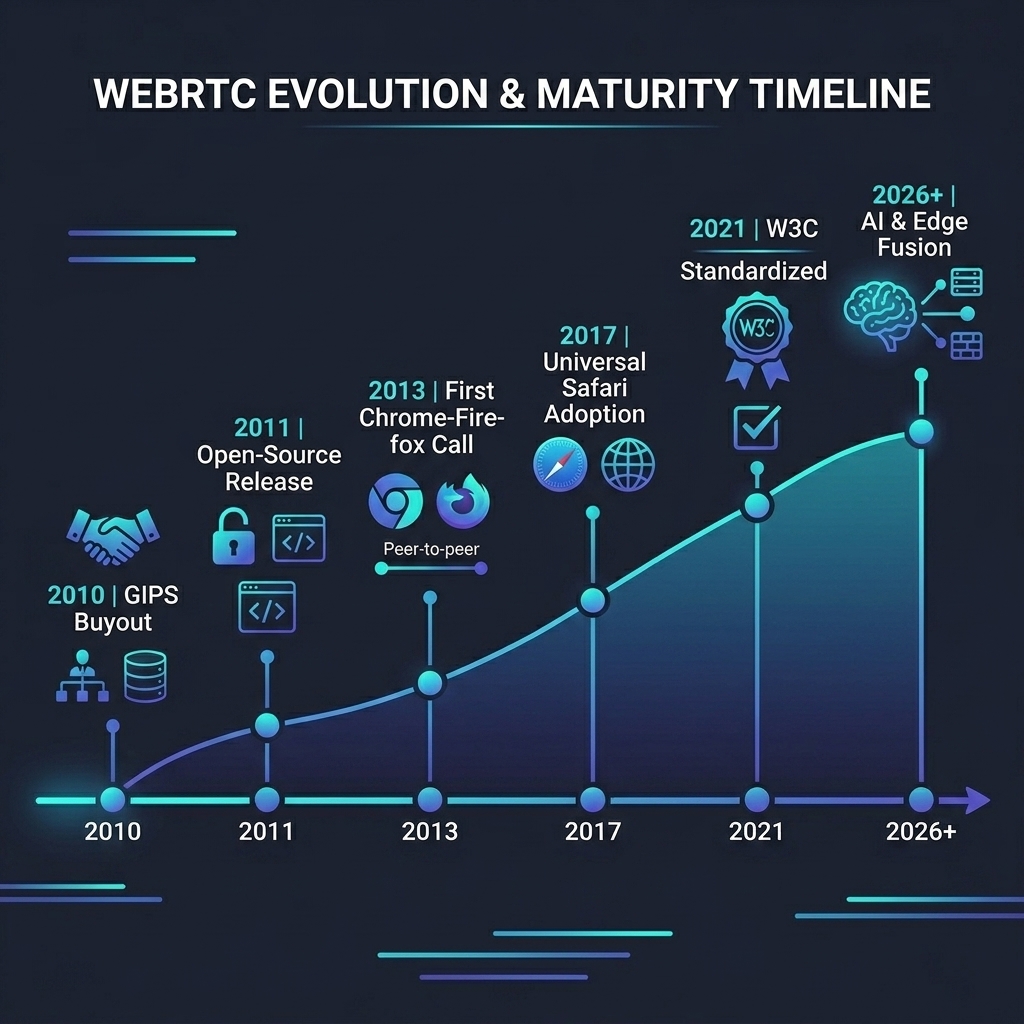
WebRTC Timeline
| Timeline and Year |
Milestone Category |
Industry Impact |
| 2010 |
Acquisition Foundation |
Google acquires Global IP Solutions (GIPS) for $68.2M, obtaining the critical audio/video codecs
(iSAC, iLBC) and packet transmission assets.
|
| 2011 |
Open-Source Launch |
Google open-sources the WebRTC codebase and W3C and IETF establish dedicated working groups to
begin draft specifications.
|
| 2013 |
Interoperability Proof |
The first successful cross-browser real-time P2P video call is made between Google Chrome and
Mozilla Firefox, validating the protocol design.
|
| 2017 |
Universal Browser Adoption
|
Apple Safari 11 introduces native support for WebRTC, ending years of ecosystem fragmentation and
making P2P browser communication fully ubiquitous.
|
| 2020 |
Global Scaling |
The COVID-19 pandemic drives an unprecedented explosion in low-latency real-time video dependence,
forcing infrastructure platforms to scale to billions of daily call minutes.
|
| 2021 |
Official Standardization
|
W3C officially publishes WebRTC 1.0 as a formal Web Recommendation, alongside the publication of the
IETF RFC 8825 core specification suite.
|
| 2026 |
AI & Edge Fusion |
WebRTC matures into a primary pipeline for conversational AI engines, real-time spatial computing
virtual environments and edge server ingestion.
|
Final Thoughts
WebRTC transformed browser communication from plugin-dependent proprietary systems into secure, open,
interoperable, low-latency real-time infrastructure. Its evolution involved browser competition, consortium
politics, codec wars, telecom influence, enterprise
scaling, cloud-native architecture and AI-driven communication systems.
WebRTC is no longer simply a browser technology. It has become one of the core communication foundations of the
modern internet.